
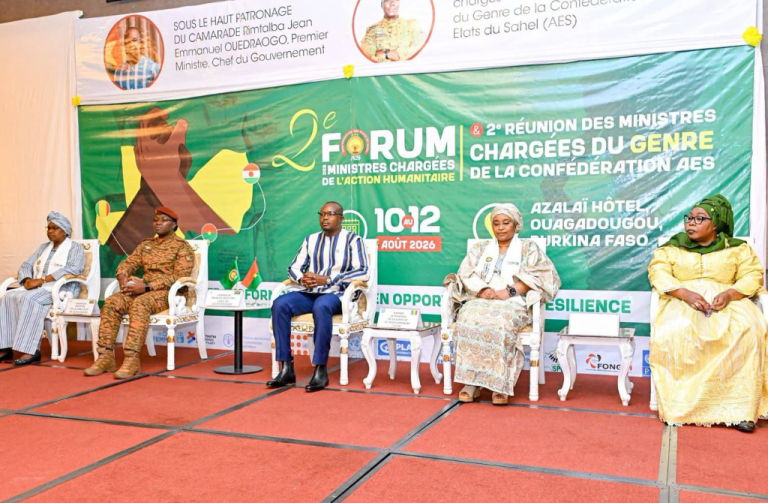

Between rising insecurity, massive population displacements, and climate pressure, humanitarian needs have never been more urgent. In the face of this reality, the Confederation of Sahel States (AES) has chosen to make solidarity a pillar of its collective action. Evidence of this commitment came with the holding, in Burkina Faso, of the second edition of the AES Humanitarian Forum, coupled with the second meeting of ministers responsible for Gender affairs within the confederal space.
These two gatherings, which bring together delegations from Burkina Faso, Mali, and Niger, are no mere diplomatic formalities.
They embody a clear political will: to place human beings at the heart of the confederal project.
By bringing together decision-makers, experts, and field actors, the forum provides a space for dialogue and coordination to respond in a concerted manner to the crises that are destabilising the region.
The originality of this edition lies in its integrated approach. Instead of treating humanitarian emergency and gender issues separately, the organisers chose to link them.
Discussions focus on community resilience, but also on women’s empowerment, recognised as essential levers for stability and local development.
This dual focus reflects a profound vision: there can be no sustainable humanitarian response without the active and informed participation of women, who are both the primary victims of crises and the primary drivers of solutions.
Beyond statements, the AES intends to take concrete action. Pooling efforts, sharing experiences, and harmonising public policies are at the heart of the proceedings.
The three countries aim to move beyond isolated approaches to build a common strategy; one that is more effective and more respectful of local realities.
In doing so, the Confederation is sending a strong signal to the international community: The Sahel cannot be reduced solely to its security challenges.
It is also a space for human cooperation, where solidarity and the dignity of populations take precedence over divisions.
By investing heavily in humanitarian causes and gender equality, the AES is asserting its identity and cohesion, while laying the groundwork for a more resilient future for its 70 million inhabitants.
Ultimately, this double gathering in Ouagadougou is not an end in itself. It is part of an enduring dynamic—one of a confederation that understands that its legitimacy will be won first and foremost on the human front.